
The true price of being wrong in your business
Mastering Business Flow, Episode 46
Apple Podcasts | Spotify | YouTube
You are playing a deadly game of chance with your hard-earned profits. Most entrepreneurs look at their spreadsheets, see a team spread razor-thin, and assume they just need to work harder. But your bank account isn't waiting for more hustle; it’s waiting for a clear system that makes failure impossible. When you launch a new product line, software feature, or revenue stream based entirely on your intuition, you aren't taking a calculated risk—you are burning your team's energy and draining your profits. Every year, thousands of new initiatives launch into the market, and according to Harvard Business School, the failure rate is a staggering 95%. That penalty applies to Google, it applies to Coca-Cola, and it applies directly to small businesses doing $10 million in annual revenue. Past revenue does not protect you from future failure. It is time to stop operating like an overpaid firefighter trapped in your own chaotic operations and start moving into the absolute clarity of a Strategic CEO.
Strategic CEO Note: While Cindy Alvarez’s brilliant book Lean Customer Development was originally built for Silicon Valley tech giants, today I am completely stripping away the corporate jargon and translating these exact scientific product validation frameworks specifically for the exhausted small business owner trapped inside their own daily operations.
Key takeaways
Ditch the intuition myth: Past revenue and gut instinct are terrible shields against market failure; raw data and objective metrics are the only guardrails that protect your future scale.
Isolate the core assumptions: Break down your next big idea into a simple formula: “I believe [this specific type of person] experiences [this explicit problem] when doing [these types of tasks].”
Validate before you build: Run 5 to 10 highly disciplined conversations with target clients to let the market pull the final solution out of you before writing a line of code or buying inventory.
00:00 The 95% tax: Why big revenue will never protect a flawed launch from absolute failure.
02:15 The owner's filtering problem: Pulling small business owners out of the creative trap so they can focus on data.
04:10 The coach story: The exact time-drain invoice I paid when building a program nobody wanted to buy.
06:45 The 1-10-100 software rule: Why fixing an unvalidated offer after launch costs 100x more than doing it upfront.
09:20 The Kodak post-mortem: How a 130-year industry giant filed for bankruptcy by relying entirely on internal gut feel.
12:05 The 10-minute brain dump: A simple exercise to pull your cognitive assumptions out of your head.
15:30 Finding the highly motivated: Targeting the explicit clients who are actively looking for an emergency solution.
18:15 The Henry Ford fallacy: Why you must interview clients to capture their current constraints, not their future product designs.
21:40 The diagnostic checklist: The four specific tactical questions required to capture factual operational reality.
24:55 The five whys audit: Peeling back the conversational layers to uncover a prospect's true root motivation.
The staggering cost of building what nobody wants
Most entrepreneurs don't suffer from a shortage of ideas; we suffer from a filtering problem. We read a new book, listen to a podcast, or spot a competitor doing something cool, and we instantly pivot our team. This behavior lands your operations straight into a chaotic swamp of reactive firefighting.

CB Insights tracked the data and found that 43% of all new business initiatives fail purely because there was zero market fit. It wasn't bad engineering, bad market conditions, or a lack of funding—it was the stark reality that they spent months building a product that nobody wanted to buy in the first place.
Don't think that just because you are an established business, you are immune to this. Even the biggest companies crash when they stop validating. Consider Kodak. They were a powerhouse in business for 130 years before filing for bankruptcy in 2012. They didn't lack the technology; they actually invented the digital camera. Kodak failed because they relied entirely on their gut instinct and assumed they knew exactly what their customers wanted without ever testing the changing market.
When you look from afar at a shiny new offer, it looks clean because you aren't inside the messy middle of it yet. But the minute you pull your team off your core project to chase it, you split your execution base across multiple half-built bridges. Every hour you spend doing customer research upfront saves you five, ten, or a hundred hours of painful cleanup later. Look at the historic 1-10-100 rule: it costs $1 to fix a structural problem before you build, $10 to fix it during production, and $100 to fix it after it is launched out into the public world.

Shifting your mindset to be a scientist
To transition out of this trap, you must build strict guardrails around your creativity. You need to shift your mindset entirely, step out of the visionary trap, and think like a clinical scientist. This means you do not assume you know anything until you test it. You break the scientific process down into three simple subsets:
1) Identify your assumptions
Pull out a blank piece of paper or open a document on your computer.
Set a timer for exactly 10 minutes.
Brain-dump every single thing you believe to be true about your customer. Write down what they think, how they spend their time, how they make decisions, and what their limits are.
Do not worry about being right or wrong; just get the assumptions out of your head so you can clearly see what has not been proven yet.
Group and organize your ideas. You can use a tool like Business Canvas.
2) Create hypotheses
Look at your brain-dump list and organize your thoughts into a testable hypothesis statement.
Simplify this by focusing on three clear things: the type of people, the type of problem they have, and the task they are trying to do.
Write it out like a formula: “I believe this type of people experience this type of problem when doing these types of tasks.”
Keep your target narrow. As Cindy Alvarez notes in Lean Customer Development, narrow targets can be disproved or validated infinitely faster than wide ones. If you test whether "animals like water," it takes a lifetime; if you test whether "cats like water," you get your answer in seconds.
3) Find the right people to test your hypothesis on
Look for potential customers who are highly motivated and passionate about solving this exact problem.
Target people who meet these key characteristics: they have the problem, they are actively aware of it, and they are already trying to find a solution.
Do not look for regular users yet; find the desperate buyers who are willing to try your ugly, unfinished beta product because they want relief from their pain.
Build feedback loops into your daily business routines. Get your frontline employees to capture customer complaints and feature requests, or ask a simple, targeted factual question in your weekly newsletter to collect hard data.

The low-cost validation playbook for strategic conversations
You do not need massive corporate focus groups or expensive market studies to filter your next revenue stream. You need 5 to 10 deep, strategic conversations with highly motivated target clients. When you get these people on the phone, your explicit job is to document their factual reality, not sell them on your brilliant vision. If you ask them what they want, they will simply tell you they want a faster horse. Your goal is to map their actual behaviors by using open-ended diagnostic loops:
Map the baseline routine: Start by asking, "Tell me about the last time you executed this task..." forcing them to recount real step-by-step history rather than future dreams.
Identify the structural blocks: Deploy the magic wand framework: "If you could do anything you're blocked from doing today, what would that look like?" This surfaces hidden environmental, cultural, or budgetary constraints.
Uncover the true economic motivation: Use the continuous “Tell me more” prompt to trace frustrations straight to the root trigger.
Audit your own listening filter: Never leave a conversation assuming you heard correctly. Use the strict commitment clarification loop: "I want to make sure I'm completely clear on this. You're saying X, Y, and Z. Did I get any of that wrong?".

The 24-hour challenge
Pick the primary project or new revenue stream you are currently planning to launch this quarter. Before you allow your team to build a single asset, map out your core hypothesis statement using the step-by-step formula: “I believe [Type of People] experience [Type of Problem] when trying to do [Specific Task].” Identify three actual target clients in your network who fit this criteria, send them a low-friction message, and book a simple 15-minute diagnostic problem audit this week.
Mentioned resources
Lean Customer Development: How to Find Out What Customers Need But Don't Tell You by Cindy Alvarez.
The One Thing: The Surprisingly Simple Truth Behind Extraordinary Results by Gary Keller.
George Labovitz and Yu Sang Chang (alongside co-author Victor Rosansky) formally introduced and detailed the 1-10-100 rule in their 1992 book,"Making Quality Work: A Leadership Guide for the Results-Driven Manager"
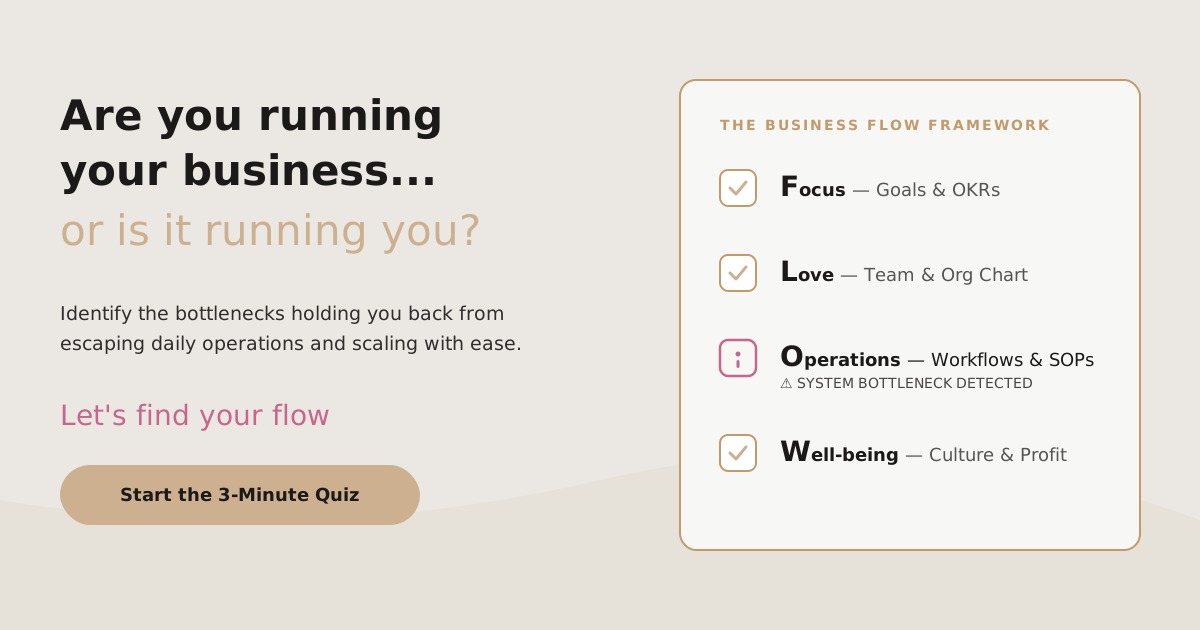
Stop Firefighting. Find Your Flow.
If your days are still a blur of reactive sprinting, your calendar is running on stress instead of systemized automatic routines. You don’t have a growth problem—you have an irregularity problem.
Stop guessing where your operational infrastructure is leaking profit. Go to http://masteringbusinessflow.com/assessment right now and take the Business Flow Assessment.
In less than 10 minutes, this free operational diagnostic tool acts as a clinical mirror, stripping away the noise to pinpoint the exact structural clogs slowing down your execution base. Take the Business Flow Assessment, get your customized roadmap, and let's build a business that runs cleanly whether you show up or not.
Related episodes to listen to next
Episode 12: The Science of CEO Loneliness: Why You Can’t Grow in Isolation
Episode 13: Honing in your focus on one thing to scale
Episode14: The "Messy Middle" of Growth
Episode 16: Building operational systems to handle customer risk and validation